Tuesday, May 9, 2023

The 'Blockbuster' story!

Blockbuster Video was founded in 1985 by David Cook in Dallas, Texas. It quickly became a sensation, with stores popping up all over the country. At its peak, Blockbuster had over 9,000 stores in 25 countries, making it the world's largest video rental chain.

Blockbuster's success was largely due to its innovative business model. Instead of selling videos outright, it rented them out for a fraction of the cost. This made movies more accessible to the general public and helped drive the growth of the home video industry.

In the early 2000s, a new technology emerged that would change the way people consumed media: streaming video. Companies like Netflix and Hulu started offering online streaming services, which allowed people to watch movies and TV shows instantly without having to leave their homes.

At first, Blockbuster ignored these new players in the market, believing that its loyal customer base would continue to rent physical DVDs and VHS tapes. However, as streaming became more popular, Blockbuster began to lose market share.

To make matters worse, Blockbuster also faced stiff competition from other video rental chains, such as Hollywood Video and Movie Gallery. These competitors offered lower prices and a wider selection of movies, which drew customers away from Blockbuster.

Despite these challenges, Blockbuster continued to operate in much the same way it always had. It focused on expanding its physical stores rather than investing in digital technology, and it refused to lower its prices or change its business model.

As a result, Blockbuster's customer base continued to dwindle. In 2010, the company declared bankruptcy and closed all of its remaining stores.

The story of Blockbuster Video is a cautionary tale about the dangers of failing to adapt to changing market conditions. The company was so focused on its past success that it failed to see the future coming. By the time it realized its mistake, it was too late to recover.

Interestingly, Netflix played a major role in Blockbuster's downfall. In the early 2000s, Netflix was a small company with a big idea: offer an online DVD rental service. At the time, Blockbuster was the dominant player in the video rental industry, with thousands of stores and millions of customers.

In 2000, Netflix co-founder Reed Hastings approached Blockbuster with an offer to partner with them and run the company's online rental service. Hastings believed that Blockbuster's brand recognition and customer base would give Netflix the boost it needed to succeed.

However, Blockbuster executives were dismissive of Hastings' proposal. They believed that online rentals were a passing fad and that customers would always prefer to rent physical DVDs from their local stores. As a result, Blockbuster declined the offer, and Hastings went ahead with his plan to build a standalone online rental service.

Over the next few years, Netflix grew rapidly, and Blockbuster began to lose market share. In 2004, Blockbuster finally launched its own online rental service, but by then, it was too late. Netflix had already established itself as the leader in the market, and Blockbuster's online service struggled to compete.

As Netflix continued to grow, Blockbuster's financial situation began to deteriorate. In 2007, the company announced that it would be closing over 500 stores and laying off thousands of employees. Meanwhile, Netflix was expanding its streaming service, which allowed customers to watch movies and TV shows instantly over the internet.

In a final twist of fate, Blockbuster actually had the opportunity to buy Netflix in 2000 for just $50 million but passed on the opportunity. Today, Netflix is worth over $200 billion, while Blockbuster is no more.

The lesson here is clear: businesses must be willing to adapt and evolve if they want to survive in a rapidly changing market. The rise of digital technology and online streaming may have been the nail in Blockbuster's coffin, but the real cause of its downfall was its failure to adapt and innovate.

Despite its demise, Blockbuster remains a beloved cultural icon. Many people have fond memories of renting movies from their local Blockbuster store, browsing the aisles for the latest releases, and chatting with the friendly staff. The company's legacy lives on in popular culture, with references to Blockbuster appearing in movies, TV shows, and even video games.

In recent years, there has been a renewed interest in Blockbuster, with several documentaries and podcasts exploring the rise and fall of the video rental giant. These stories serve as a reminder of the importance of innovation and adaptation in the business world, and the consequences of failing to keep up with the times.

 As for Netflix, the company has continued to evolve and innovate since its early days as a DVD rental service. Today, it is a global entertainment powerhouse, producing award-winning original content and revolutionizing the way people watch movies and TV shows.


Sunday, May 7, 2023

Data Visualisation- The Art of Data Science

 In today's digital age, data is everywhere. From the number of steps, we take each day to the performance of the stock market, we are inundated with vast amounts of information. But how do we make sense of all this data? That's where data visualization comes in.

Data visualization is the process of creating visual representations of data to help us understand patterns, trends, and relationships. It has been used throughout history to reveal insights and drive positive change. Here are some fascinating examples of how data visualization has changed the world.    

 ·         John Snow's Cholera Map

In 1854, London was hit by a devastating cholera outbreak. The medical community at the time believed that the disease was spread through the air, but physician John Snow had a different theory. He believed that cholera was transmitted through contaminated water.

To prove his theory, Snow created a map that showed the locations of all reported cases of cholera in London. He discovered that the cases were clustered around a single water pump on Broad Street. Snow removed the pump handle, and the outbreak subsided.

Snow's cholera map was an early example of data visualization being used to solve a public health crisis. It helped to change the way we think about disease transmission and led to improvements in sanitation and public health.

·         Florence Nightingale's Coxcomb Chart

During the Crimean War, nurse and statistician Florence Nightingale became concerned about the high mortality rate of soldiers in military hospitals. She collected data on the causes of death and created a visualization called the "coxcomb chart" to show her findings.

The chart revealed that more soldiers were dying from preventable diseases than from battle injuries. Nightingale used the chart to advocate for reforms in military hospitals, and her work helped to improve the quality of medical care for soldiers.

·         Charles Joseph Minard's Map of Napoleon's March

In the 1800s, French engineer Charles Joseph Minard created a visualization that showed the size of Napoleon's army during his march to Moscow and subsequent retreat. The chart showed the number of soldiers at each point in the journey, as well as the temperature and terrain.

Minard's map revealed that the harsh Russian winter, not enemy attacks, was responsible for the majority of the losses suffered by Napoleon's army. It was a groundbreaking example of data visualization being used to debunk common misconceptions and challenge widely held beliefs.

·         William Playfair's Line Graphs

In the late 1700s, Scottish engineer William Playfair invented the line graph. This simple visualization technique shows data points connected by lines, allowing us to see trends and patterns over time.

Playfair's line graphs were nothing less than revolution in data visualization. They allowed us to see patterns and relationships that might not be apparent from raw data, and they helped to pave the way for more sophisticated visualization techniques in the years to come.

·         Edward Tufte's The Visual Display of Quantitative Information

In 1983, data visualization expert Edward Tufte published a book called The Visual Display of Quantitative Information. The book laid out a set of principles for effective data visualization, including the importance of simplicity, clarity, and accuracy.

Tufte's book helped to establish data visualization as a legitimate field of study and inspired a generation of data scientists and visualization experts. It also helped to raise awareness about the power of data visualization to reveal insights and drive positive change.

In more recent times, data visualization has been used to tackle pressing social issues. For example, The New York Times used a map to show the concentration of poverty in New York City. The map revealed that poverty was not evenly distributed throughout the city, and that certain neighbourhoods had much higher poverty rates than others. This information was used to call attention to the issue and to advocate for policy changes to address it.

In today's world of big data, data visualization is no longer a luxury but a necessity. It's not enough to just collect data; we must be able to make sense of it in order to make informed decisions. By using visualizations like charts, maps, and graphs, we can unlock insights and reveal patterns that might otherwise go unnoticed. Whether you're working in healthcare, finance, marketing, or any other field, data visualization can help you to communicate complex information and drive meaningful change. So don't underestimate the power of a well-designed chart or graph – it just might be the key to unlocking your next breakthrough.


Friday, May 5, 2023

Tinkered Thinking!

Do you ever feel like your brain is playing tricks on you? That's because it is! In "Thinking, Fast and Slow," Nobel Prize-winning psychologist Daniel Kahneman explores the two systems that make up our thinking: the fast, intuitive System 1, and the slow, deliberate System 2.

Kahneman explains that while System 1 helps us quickly make judgments and decisions, it can also lead us astray with biases and heuristics. For example, have you ever been scared of flying, even though statistically it's safer than driving? That's because plane crashes get more media coverage, making them more available in our minds and leading us to overestimate their likelihood.

Similarly, the anchoring effect shows how our decisions can be influenced by the first piece of information we receive. A group of judges were found to be more likely to grant parole early in the day, when their decision-making capacity was fresher. And the conjunction fallacy shows how we can be swayed by specific details, even if they're less likely than general outcomes. For instance, people were found to be more likely to believe someone was a feminist banker than just a banker, even though the latter is more probable.

But it's not all bad news – Kahneman also explores how we can harness System 2 to make better decisions. By slowing down and analyzing information more deliberately, we can overcome the biases of System 1. For instance, we can use somethings like endowment effect to our advantage by recognizing that we overvalue things we own. (The endowment effect is a cognitive bias that refers to our tendency to overvalue things we own or possess. We tend to attribute more value to something simply because we own it, and we're reluctant to part with it even if it's not objectively worth as much as we think. For example, if you own a baseball that you've had for years, you might be willing to pay more to keep it than you would be willing to pay to buy a new one. This is because the baseball has sentimental value to you, and you attribute a higher value to it simply because you own it.)

Kahneman also highlights the importance of the peak-end rule, which shows that our memories of events are shaped by their emotional peak and how they end. So, even if a medical procedure is painful, if it ends on a positive note, we're more likely to remember it positively and be willing to repeat it.

Another interesting point highlighted is about the framing effect. The framing effect, which is the way in which the same information can be presented in different ways to influence decision-making. He gives the example of a flu outbreak being presented as "10% of people will get the flu" versus "90% of people will not get the flu", which can significantly affect people's willingness to get vaccinated. We can keep this in mind and while taking important decisions, being aware about this consciously, will help arrive at better and considered decisions.

In "Thinking, Fast and Slow," Kahneman provides fascinating insights into the quirks of our thinking, and how we can use this knowledge to make better decisions in our daily lives. Simply being aware about these ways of how brain functions, our cognitive biases etc., can help us make better decisions.

Friday, May 1, 2020

Vaccine against Virus !


When will everything be normal? When all this is going to end? These are few of the most discussed and searched topics these days. Finding a cure to the disease may well end all these things. But isn't prevention better than cure? For the infectious diseases like COVID-19, if we wish to continue our routine life then vaccine is the most effective way of prevention. So today entire mankind, in an unprecedented manner, is united for one single challenge of developing a vaccine against COVID-19. 

By now we all know that SARS-Cov-2, the virus causing COVID-19 is a novel type of corona virus. Earlier outbreaks of SARS, MERS were also caused by corona virus only. So if the vaccines for these diseases were in place by now, scientists believe that we would have been in much better position today and would have developed the vaccine against COVID-19 in very short span of time owing to the similar nature of the virus. In fact some of the companies like Inovio along with CEPI (Coalition for Epidemic Preparedness Innovations) had developed the vaccine in epidemic-speed and even started the human trials. But when these outbreaks-fortunately- sputtered out, the funding and interest in development of vaccine waned. 

There are multiple stages in development of vaccine. A safe and effective vaccine has to go through all these stages. Vaccine against COVID-19, corona virus will also have to go through all these stages.
Stages of development of vaccines. Source: sciencedirect.com
But despite all the odds today around 115 COVID-19 vaccines are in development at different stages.
Roughly speaking there are 7 stages before actual use of vaccine at mass scale. These stages include- discovery & exploratory stage (laboratory R&D), preclinical stage (involves testing on the animals), phase-1 (testing the vaccines on dozens of humans), phase-2 (testing on around hundreds of humans), phase-3 (testing on around thousands of humans), regulatory approval and finally manufacturing & launch of the vaccine.  

Type, Variant and Manufacturing capacity: The triad of vaccine development
There are different types of the vaccines. Some of the important ones are as follows:
1. Live vaccines : in which the pathogen is induced in "attenuated" form. When the body detects this 'antigen', immune system of body develops its own 'antibodies' to fight against these antigens. Now this antigen is kept in its memory by the body and whenever actual pathogen attacks the body, memory system triggers the antibody response.

2. Inactivated vaccines : These vaccines work on similar principal as above, only difference is that they contain the killed pathogens instead of attenuated ones. 

3. RNA vaccine- RNA & DNA vaccines are the future of vaccines. Instead of injecting the pathogen's antigen directly into the body, RNA vaccines induce the genetic code needed to produce the antigen itself in human body. When antigens appear on the outside of the cell, body's immune system attacks them and also learns how to fight future intruders of such types. Therefore by this process, human body itself becomes vaccine manufacturing unit. 

Around 115 different vaccine development projects for COVID-19 (corona virus) are ongoing across the world. These are various typed of vaccine development projects based on different types of vaccines.
Distribution of ongoing vaccine development projects for COVID-19.
Source: CEPI
WHO, many scientists, businessmen and philanthropists like Bill Gates are championing the cause for RNA based vaccine. This is because RNA vaccines are easier, faster and safer to manufacture unlike the traditional vaccines which require much of the biological material for production. But the risk involved is that world has never ever launched RNA vaccine in its final stage yet. Though research and some trials of RNA vaccines are conducted earlier but final mass production after successful trials has never happened.

Apart from the type of vaccine, second catch is of the variant of vaccine depending upon the method of administering the vaccine. This includes oral vaccine, intra-dermal  vaccines (injected into the top layers of skin), muscular vaccines (injected into the muscles). For COVID-19 we need the vaccines which can be administered easily because this vaccine will be required for entire 7 billion population of the world. At such a large scale, the faster and easily deliverable vaccines are important. Companies like Bharat Biotech are developing a vaccine named 'Coroflu', which will be a nasal vaccine to be administered through the nose. They are collaborating with University of Wisconsin. Whereas ChAdOx-1 developed by Oxford University is intra-dermal vaccine and currently at the stage of human trials.

Now next question is by when we will get the vaccine ready at mass scale. What we have discussed till now focuses mostly on the R&D of the vaccine. But the very important and complex stage comes after that, the stage of manufacturing. For 7 billion vaccine doses, we will require minimum 7 billion vials and equal number of stoppers. And suppose if vaccine requires double dose, then we need 14 billion of these components. Also the vaccines require specific conditions for storage like specific temperature etc. After manufacturing, the supply chain management and logistical issues like proper transport of all these vaccine doses to desired places is also a challenge in itself. Each kind of vaccine requires its own kind of factory for manufacturing. as we don't know yet which type of vaccine will play out successfully, it is difficult to build desired factories also. But still Indian manufacturers like Serum Institute have already began setup for ChAdOx-1 vaccine developed by Oxford university and will start manufacturing once the successful results of vaccine are received. Also Bill&Melinda Gates Foundation have declared to keep 7 factories ready for 7 different types of vaccines even before these vaccines are established to be successful to reduce the time for manufacturing in the future. This is the real bet for humanity all of them are taking. 

Who should get it? 
One of the final but very important issue we must discuss is who will get the vaccine first. Considering the huge and unprecedented demand for the vaccine across the world and considering the phased manufacture of vaccine, question of prioritizing the distribution might arise. This is a very difficult question and a kind of ethical dilemma. Should it be given to elderly persons first considering the higher risk they face or should it be given to health workers first who have direct exposure to the disease? Or should the developing and manufacturing countries should have the first right on the vaccine? Countries across the world have closed their borders today. Except few noble examples like that of India, which is helping other countries in such difficult times, the game of name & shame is in full fledge amongst different countries. But to address this question of 'who should get the vaccine', we need the global cooperation and collaboration like never before. The equitable distribution strategy must be decided by all.

Strong global partnership between governments across the world, research laboratories, manufacturers, funders, national health regulators of all the countries is the need of the hour. Being a global leader in manufacturing the vaccines, India has potentially the huge role in saving the fate of humanity. With all the efforts in right direction, lets hope for speedy & pandemic-speed vaccine sooner at the end of the tunnel.

Sources : - 
-CEPI (Coalition for epidemic preparedness Innovations)
- GAVI, the public private Vaccine Alliance
- Talks by Bill Gates
- Oxford University

Saturday, April 25, 2020

Tracking the Virus.

These are the challenging times and day in and day out everyone is talking about the corona virus. India so far has dealt the pandemic quite effectively. Its been a month since the lockdown in India has started and therefore this is a right time to look at the data, patterns and trend of the spread of COVID-19 in this last one month.

As in the earlier article, here also the data for number of confirmed cases is sourced from WHO's daily situation reports for uniformity and global view point. WHO data has some limitations because of reporting issues, methodology of reporting by different countries etc, but as of now no other source is available to get the global data. 

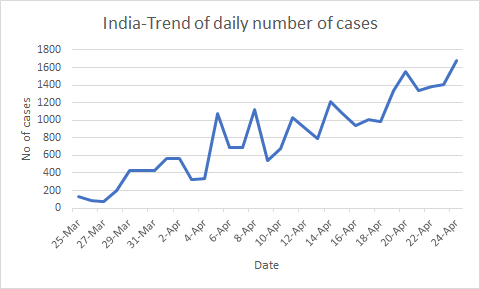
The graph shows trend of daily number of cases of COVID-19 found in India since 25th March. This data helps in getting the pattern of number of confirmed cases of COVID-19 in one month of lockdown in India. Thus it helps in getting to know the impact of lockdown in flattening the curve of corona spread in India.
Let us first start with the trend in the number of cases in this last one month in India. In the country of the size of India, many of the epidemiologists are predicting that numbers will be tremendously huge.

As can be seen from the graph, daily number of the cases are certainly increasing which is a cause of concern. If we consider the average, in this last one month, daily 808 confirmed cases were found. But micro level view suggest that the average for the first half of the month is just around 480 whereas for the second half it is around 1117. Therefore the average cases found per day are on rise. But the percentage growth of cases in India is lesser than many of the western countries.

Though the global picture in this regard is very bleak, India cannot afford to take relief from the fact that daily rise in number of cases is comparatively less. Timely lockdown and social distancing measures have certainly played key role in keeping the numbers within bound till now, but slightest of the error and violation of social distancing norms may cost a lot. 

Now if we see the trend of percentage of growth of cases day on day basis, then it is continuously declining in India specially since 8th of April leaving aside some sporadic spikes. Data shows that from 20th April to 24th April the percentage growth of daily cases is hovering between 7% to 8%. If we consider the the pattern of  daily percentage growth rate of confirmed cases in some of the worst hit countries of the world, and apply the same pattern to Indian scenario, factoring the strict lockdown measures in place, then by 3rd of May there will be around 45000 confirmed cases going as per the growth pattern. As per the similar statistical model and growth rate pattern, suppose the same lockdown provisions are extended beyond 3rd May till 18th May, then the number of cases by 18th May will be around 70000. 
(Please note that these are predictions are completely based on the statistical patterns and trends across the countries. Any major event or mishap contrary to the social distancing norms etc may derail the pattern. Also with the time being, testing capacities are also ramped-up to various degrees which will also affect the number of cases accordingly. Also the policy decisions like extending the lockdown cannot be merely taken on the basis of statistical models. The situation may be assessed as it unfolds and suitable decision in this regard may be taken considering the lives and livelihoods of all.) 

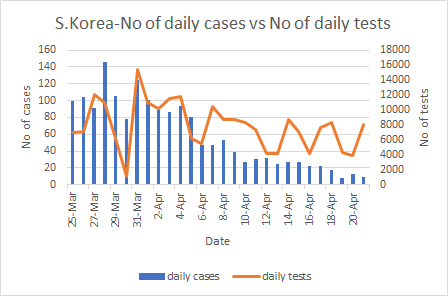
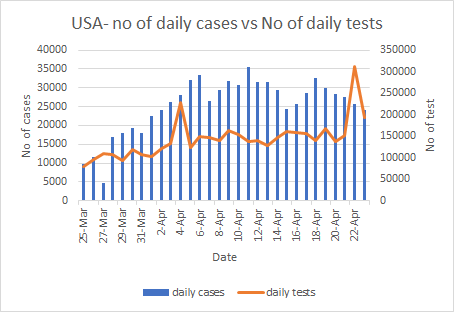
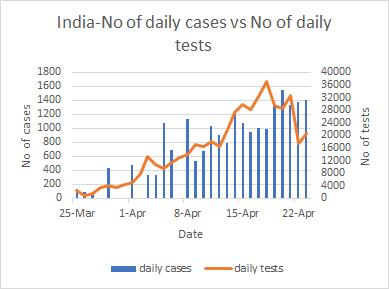
Now as far as testing capacities are concerned, it will be interesting to take a look at the pattern between number of cases vis-a-vis daily number of cases. 


S. Korea is praised a lot for its testing capacity which is quite high in terms of per million population. There is one other major factor to determine whether a country is carrying out optimal tests- the ratio of average daily tests performed to that of average daily number of confirmed cases. This ratio implies that number of tests performed on any given day must be more than number of cases on that day by the factor equal to this ratio. For the period between 25th March to 21st April this ratio is 135.5 for S.Korea. This essentially means for one confirmed case, S.Korea is testing around 135 samples. For the same period, this ratio for USA is 5.3 whereas for India it is 24. 

India is rapidly ramping-up the testing capacity and by 3rd May this ratio for India should be minimum 50 for entering the post-lockdown phase effectively, securely and sustainably. For reaching to this ratio, we will have to step up the testing capacity by 35 to 40% day on day which is currently growing at the rate of around 10% day on day between 25th March to 23rd April.

As can be seen from the graph showing the cumulative tests carried out for COVID-19 by S.Korea vis-a-vis by India. In case of India, the growth rate of number of tests specially from 10th of April is certainly assuring. Participation of the private players, rapid testing kits, exploring the option of pooled tests options specially in the hotspot areas, nudging more and more people to voluntarily come forward for getting tested are some of the options for increasing the testing capacity.

The general observations of the last one month can be summed up as follows:
1. The last one month has shown us that in the time of crisis in India many many hands come forward for the help and assistance which is very assuring thing in such unpredictable times. All such efforts will be more effective if better coordination and synergy between work of civil society, NGOs, government, private sector can be achieved.

2. Another important area is de-stigmatization of COVID-19 which in long run will be very detrimental. Social, spiritual, religious leaders in local areas can play important role in this regard. 

3. All the disasters require training to handle them effectively. But effective training is feasible only prior to the onset of disaster. The lack of training leads to panic, stigma, fear-mongering and chaos at the time of onset of disaster. Therefore training to NSS, NCC candidates, local volunteers, NGOs and very importantly the members of PRIs including gram-panchayat at village level, panchayat samiti at tehsil level and zila parishad at district levels. Recently Prime Minister has communicated with Sarpanchas of Gram Panchayat across the country.

4. COVID-19 in a way is the first pandemic after social media became so dominant. In this era we are not just fighting the pandemic but 'Infodemic' as well as WHO is also highlighting. We have experienced disastrous effects of misinformation, rumors in the incidences like mob killing in Palghar, huge crowd gathering in Bandra, Mumbai etc. Therefore this is high time to simultaneously fight this infodemic. Taking action against those spreading rumors, misinformation is necessary but not sufficient. News and information which reaches to the people first have the 'priming effect' and it sets the agenda even though later it is established as fake news. Therefore along with 'fact-check' which is essentially post-mortem work, government and all the right-intentioned people should spread the right, correct and useful information even before any fake news is spread.

Without a doubt these are testing times for all of us. But always remember, "Hope is a good thing and no good thing ever dies." 

Tuesday, April 7, 2020

Virus gone Viral !


Coronavirus: The four stages of a global pandemic - Pandemic | The ...
source-https://economictimes.indiatimes.com
7th of April is observed as World Health Day. This year's World Health Day has special significance given the crisis of health situation across the world. A small, tiny pathogen has brought the entire world to its knees including supposedly most powerful and advanced countries. 


Everyday all of us keep a tap on the rising numbers of Covid-19 patients in our region, nation and across the world. For millennials in countries like India, this is an unprecedented situation, never seen or even never heard before. It is also interesting to note that Covid-19 is first ever pandemic after rise of social media and that becaming inevitable part of all of our lives.( though social media certainly existed at the time of outbreak of MERS, recent Ebola epidemic, these diseases were limited to certain parts of the world and also social media was not that entrenched as it is today) Therefore social media has provided another medium for the virus to spread and expand. 

Though the existence of social media has given some novelty to this ongoing pandemic, epidemiologists tell us that this is nothing new per say. Epidemics and pandemics have been in existence since ages. Probably in history textbooks some of us must have read about bubonic plague, black death etc. We are awed by the number of deaths by these diseases. But it must be remembered that these are not the numbers for the sake of it but behind these numbers, there are relatives and families that get devastated, there are doctors and nurses that get frustrated. Therefore it is essential that we must learn something from the past pandemics, beyond the numbers involved. So here I will try to extract four lessons from four stories of past epidemics/pandemics:

1. Hiding the data and suppressing the news regarding pandemic is disastrous. So never do that:
It was the year 1911 and Italy had arranged the huge celebrations of 50th anniversary of birth of Kingdom of Italy. Authorities wanted it to be the biggest of its kind celebration without any obstruction. But unfortunately the Cholera outbreak started in Italy in the same year. 

Government authorities were alerted by the health department. But the government was stubborn and wanted the celebration to go unhindered without any blot on it. Therefore authorities decided to hide the information from public and world community and deny the fact that there was any outbreak in the country. Even the media personnel were bribed to suppress the news. All the telegrams which had the word cholera in them were intercepted and censored. The 50th anniversary celebrations went smooth but common people and their families paid the huge price. Remember, Cholera has 50% mortality rate if not treated rapidly.  

So never hide genuine information, this is applicable to both governments and people as well.

2. Trust the public health professionals. Immoral capitalism harms the larger public interest. 
This is again a story of Cholera outbreak of 1832 in the city that never sleeps, The New York. Some information came to the civic body of New York city that Cholera outbreak has started in Canada. The public officials were alerted as the Hudson river, Erie canal  which used to supply water to the city might get contaminated because of this. Therefore some doctors were sent to Canada to take the stock of the situation. 

The doctor came out with the hot-spot map showing that New York will certainly suffer from Cholera outbreak in Canada and strongly advised that the canal water and river water must be quarantined and be cleaned. Till then health personnel suggested to use alternate water supply sources for the city. 

But there was this private company namely Manhattan Company which used to supply drinking water to the city and surrounding areas. Also there were many brewery companies in the area. All these companies were commercially dependent on the water from River Hudson and Erie Canal. Therefore these companies were panicked by the proposal of quarantine of this water. They aggressively lobbied to the then government to cancel the proposal. Not only that but they also peddled the false theory of miasma i.e. bad smell. So they created the public opinion through media etc. that Cholera is spread by the bad smell and not through the water. The bad smell was attributed to the poor, laborers etc. And that year experienced spike in number of cases of violence against poors and specially Irish workers etc on the ground that they are spreading bad smell across the city. 

The Manhattan company flourished, breweries around the are earned a lot. (As a matter of fact, the then Manhattan  Company is today's JP Morgan Chase &Co., one of the multi-billion investment bank.) And around 2% of population of New York that year died because of Cholera (or because of greedy capitalism?)

So reposing the faith in public health institutions, their advises and their work is very essential.

3. Modern day pandemics demand all-out and comprehensive solutions. Unidimesional solutions are bound to fail.
There was outbreak of Dengue in Florida recently in 2009. Historically, Florida has always been hot-spot of dengue because of dengue prone climate and such areas surrounding it. 

The outbreak in 2009 was immediately responded as if it was only the bio-medical problem alone. The medical treatments, vaccines, drugs and entire health department was mobilized to track and contain the spread of it. Eventually though it was contained, the root cause was neglected for long.

And surprisingly root cause was not merely bio-medical but 'socio-politico-economical'. In 2008, USA and world was hit by worst financial crisis. It also resulted into foreclosure crisis. Foreclosure crisis crudely means that if homeowner fails to repay the loan, then lender can evict the homeowner and seize the property. Many such houses were seized and remained abandoned. Many of them boasted of swimming pools in them. Now abandoned houses means abandoned swimming pools. With rains in that year, all these abandoned swimming pools were filled up with water and acted as hatcheries for Dengue spreading mosquitoes. Certainly there were many other factors like suitable climate, surrounding dengue-prone areas like Cuba, Haiti etc. which also assisted this outbreak of, but the foreclosure crisis as important factor that remained neglected for long. 

Therefore modern day pandemics demand comprehensive solutions- biomedical, sociological, anthropological, administrative, psychological etc. 

4. Naming the pandemic and blaming the others might help to get score some points on diplomatic front. But it fails to help change ground realities.
We all have heard of World War-1, fought between 1914 to 1918. It is a part of our collective memory, specially of Europe. But what is not remembered, unfortunately, is the Spanish Flu which invaded Europe and then entire world immediately after World war-1 in 1918 and lasted till 1920. 

Europe had the recent bruises of WW-I and enmity, hatred between the countries was still there. Media was highly under censorship in countries like Germany, France, Britain, Italy etc. Therefore true reporting about the death tolls in a particular country was difficult task. On the contrary Spain was relatively neutral country and media had comparatively free access. Therefore media could report about the real impact of flu only from Spain. Therefore diplomatically the picture was created that only Spain is suffering from this flu and thus was named conveniently as 'Spanish Flu'. 

The countries gave priority to manage the public image of the country rather than real efforts of containment. Even history also gives more significance to WW-I in which around 20 million died compared to this Flu pandemic in which around 40 million died as per one conservative estimate. 

Thus as it is very clear that epidemics and pandemics have always been in existence. We need to acquire not just immunity from the past pandemics but also wisdom and vision to effectively tackle the future ones. 

Sources:
-'Pandemic' by Sonia Shah
-'Spillover' by David Quammen
-'No time to loose' by Peter Piot
- www.history.com